ai
The AI Treadmill: How to Stop Chasing Tools and Start Using Them
Another Tuesday, another "this changes everything" announcement.
New model. New agent framework. New coding assistant. New automation platform that promises to do what the last three promised to do, except this time it actually works. Supposedly.
You read the tweet thread. You watch the demo. You feel that familiar mix of excitement and dread - excitement because it looks incredible, dread because you haven't even finished setting up the last tool you got excited about.
So you open a new tab. Start comparing. Read three articles. Watch two YouTube breakdowns. Check the pricing page. Look at the documentation. Realize it might break your current workflow. Google or ask ChatGPT "how to migrate from [old tool] to [new tool]." Find conflicting answers. Close all the tabs.
Forty-five minutes gone. Nothing implemented. And somewhere in the back of your mind, a quiet voice says: "What's the point? By the time I figure this out, something better will replace it anyway."
Welcome to the AI Treadmill. You're running hard and going nowhere.
The Treadmill Is Real - And It's Burning You Out
Here's what the AI landscape actually looks like for a business owner trying to stay current in 2026:
A new major model drops every few weeks. Each one is "significantly better" than the last, which means whatever prompts or workflows you built on the previous version might not work the same way. Open-source tools are launching daily. Agent frameworks are multiplying. Every platform is bolting on AI features, whether they make sense or not.
And the content creators are having a field day. Every YouTube channel, newsletter, and Twitter account in your feed is racing to cover the latest release. "You NEED to switch to this." "This tool makes [other tool] obsolete." "If you're not using this, you're already behind."
It's a firehose. And you're standing in front of it with a coffee cup, trying to catch what matters.
The result? You're spending hours every week reading about AI instead of using it. You've signed up for tools you've never configured. You have half-built workflows that broke when the model updated. And the gap between what AI could do for your business and what it's actually doing gets wider every month.
That gap has a cost. And it's not just the wasted subscription fees.
Why the Treadmill Keeps Spinning
The AI Treadmill works because it exploits three things that are already running in the background of every entrepreneur's brain.
First: the fear of obsolescence. You see competitors posting about their AI-powered operations and you think "I'm falling behind." That fear is powerful enough to make you drop whatever you're working on and start researching the new thing. Not because you need it - because you're afraid of what happens if you don't have it.
Second: the dopamine of discovery. Finding a new tool feels productive. Testing a new model feels like progress. Reading about what's possible gives you the same hit as actually building something - except it's easier, faster, and requires zero implementation. Your brain literally cannot tell the difference between learning about AI and implementing AI. Both feel like you're doing something. Only one actually is.
Third: the absence of a filter. When you don't have someone you trust telling you "this matters, this doesn't" - you treat everything as potentially important. So you evaluate everything. You can't afford to miss the one tool that would actually transform your business, so you spend your time scanning all of them. That scanning feels responsible. But it's consuming the exact hours you'd need to implement any of them.
The treadmill keeps spinning because getting on it feels like the smart thing to do. Staying current feels like due diligence. But there's a massive difference between staying informed and staying stuck - and most entrepreneurs crossed that line months ago.
The Entrepreneurs Who Are Actually Getting Results
Here's what I've noticed working with hundreds of business owners on their AI implementations: the ones getting real results aren't using more tools. They're using fewer.
They picked two or three tools that solve actual problems in their business. They went deep instead of wide. They built workflows that run every day, not experiments that ran once. And they ignore 95% of the noise.
That's not because they're smarter or more disciplined. It's because they have something most entrepreneurs on the treadmill don't: a filter.
Someone or something in their environment is doing the work of sorting signal from noise. Evaluating new releases against what actually matters for their business. Telling them "this one's worth switching to" or "ignore this, it doesn't change anything for you." Testing the tools before they invest time learning them.
Without that filter, you're on your own. And on your own means every announcement is a potential priority, every new tool is a potential migration, and every week includes hours of evaluation that produce zero implementation.
How to Get Off the Treadmill: A Framework That Actually Works
You don't need to quit paying attention to AI. You need a system for deciding what deserves your attention and - more importantly - what doesn't. Here's a framework you can apply starting today.
1. Define your "Implementation Stack" - and stop changing it every month.
Right now, write down the AI tools you actually use in your business on a regular basis. Not the ones you're "testing." Not the ones you signed up for. The ones that are running, producing output, and saving you time today. (If you haven't done a full audit of what you're paying for, start with the 30-minute tech stack audit - it'll show you exactly what you're spending on tools you don't use.)
If that list is zero or one, that's your real starting point - and that's fine. If it's two or three, that's your Implementation Stack. These are the tools you go deep on. You learn their advanced features. You build real workflows. You optimize what's already working before you add anything new.
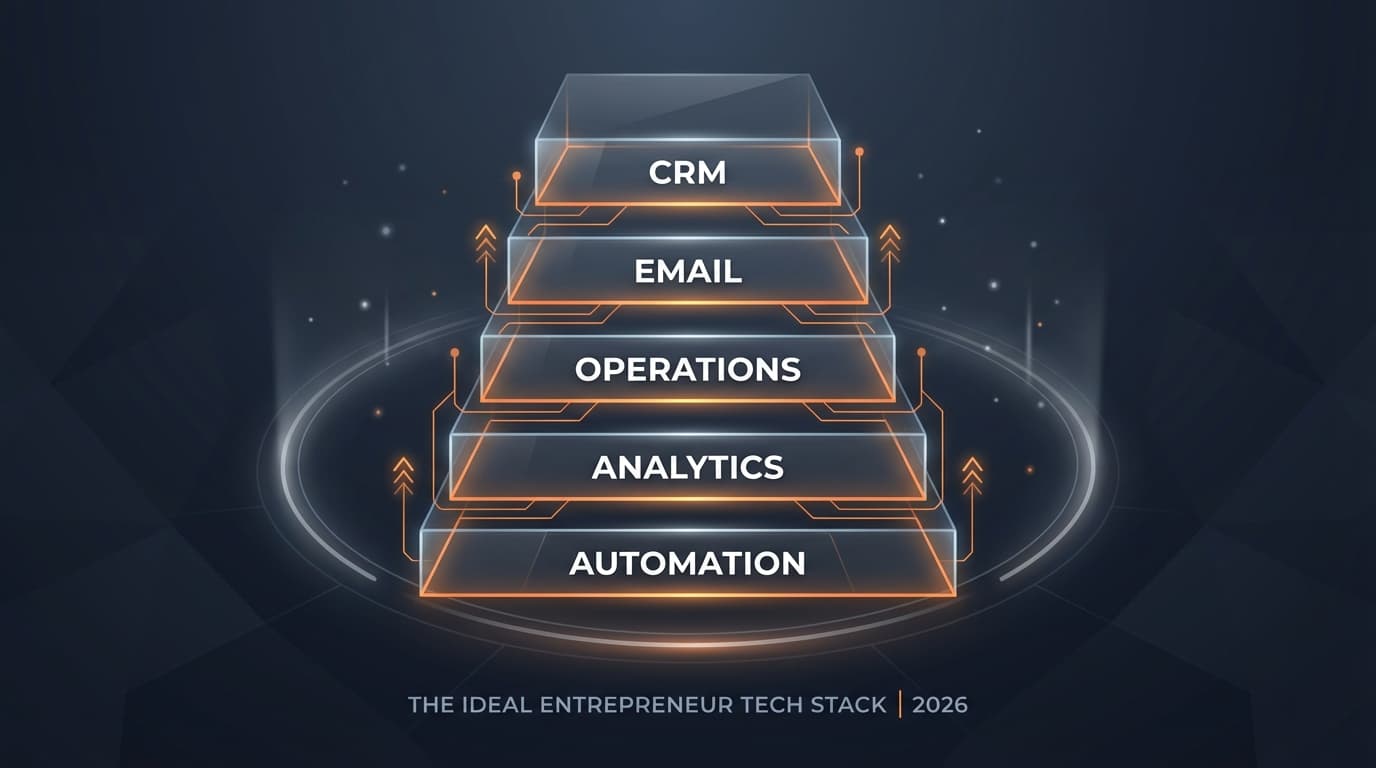
The rule: nothing new enters your Implementation Stack unless it replaces something that's already there AND the migration takes less than a day. Everything else goes on a "watch list" that you check once a month, not once a day. (For a complete framework on what a lean, effective tech stack should look like, read The Entrepreneur's Tech Stack in 2026.)
2. Apply the "Tuesday Test" before evaluating any new tool.
When you see an exciting new AI announcement, ask yourself three questions before you open a single tab:
Does this solve a problem I'm actively losing time or money on right now? Not a theoretical problem. Not a "this could be useful someday." A problem you dealt with this week.
Can I implement this in under two hours? If the learning curve is a weekend project, it's not urgent. Put it on the watch list.
Will this still matter in 90 days? Most AI announcements are incremental improvements or niche use cases dressed up as breakthroughs. If you wait 90 days, the hype will separate from the substance and you'll know if it's real.
If the answer to all three is yes, evaluate it. If any answer is no, close the tab and go back to what you were building.
3. Set an "AI Budget" - and it's not about money.
You already budget your dollars. Start budgeting your AI attention. Give yourself a fixed amount of time per week for AI exploration - I'd recommend 60 minutes maximum. Use that time intentionally: check your watch list, scan one trusted source for updates, and evaluate anything that passed the Tuesday Test.
Outside that window, you're implementing, not exploring. If a shiny new tool catches your eye on a Thursday afternoon, write it down and save it for your AI Budget time. The discipline isn't about ignoring AI - it's about containing it so it stops bleeding into your implementation hours.
4. Find one trusted filter - and outsource the scanning.
This is the highest-leverage move on the list. Instead of personally evaluating every new tool, find one person or community you trust who's doing that work already. Someone who tests things, breaks things, and reports back on what actually matters for businesses like yours.
This could be a newsletter you trust, a peer who's deep in the AI space, or a community where someone is actively building with these tools and sharing honest assessments - not hype, not affiliate links, just "here's what works and here's what doesn't."
This is something I've done my entire career - not just with AI, but with every wave of marketing technology over 24 years. I was the first certified consultant for Mike Koenigs' Traffic Geyser platform back in 2012. Mike later told me I was his "power user" who found ways to use the tool that even his own team hadn't imagined. That wasn't because I'm a genius. It was because I spent the time implementing, testing, and breaking things so the people I worked with didn't have to. One of my clients, Derek Emery, took what I implemented with that platform and grew his company from $40 million to $55 million in three months. The trusted filter didn't just save him time scanning. It made him money through faster, better implementation.
When you have a trusted filter, you go from spending five hours a week scanning to spending fifteen minutes reading a summary from someone who already did the work. That's not laziness. That's leverage.
5. Measure "AI ROI" monthly - in hours saved, not tools adopted.
At the end of every month, answer one question: how many hours did AI save me this month compared to last month? Not "how many tools did I try." Not "how many workflows did I start." Hours saved. That's the only metric that matters.
If the number went up, your Implementation Stack is working. Keep going deep.
If the number stayed flat, you're exploring without implementing. Tighten the focus.
If the number went down, you've been on the treadmill. Something you were using broke or got abandoned. Fix it before adding anything new.
The Honest Truth About Getting Off the Treadmill
These five steps work. If you actually implement them, you'll spend less time chasing tools and more time using them. Your AI usage will go from scattered experimentation to focused implementation. And that anxiety you feel every time a new announcement drops will quiet down, because you'll have a system for deciding what matters.
But here's what I've watched happen with most entrepreneurs who read advice like this: they nod along, maybe try step one, get busy by Wednesday, and the framework joins the pile of good ideas that never became habits.
Not because the framework is wrong. Because doing it alone - filtering the noise, making the right calls on what to adopt, building the workflows, troubleshooting when things break - is the same implementation gap that got you on the treadmill in the first place.
This is exactly the kind of thing we handle in the Implementation Club. When a game-changing tool drops, you don't hear about it three months later from a YouTube guru. You hear about it that week in our Slack community, with an honest assessment of whether it's worth your time. When a new model makes your current setup obsolete, you don't panic and start over alone. You show up Thursday and we migrate together. When you're stuck on a Tuesday afternoon trying to get two tools to talk to each other, you post in Slack and get a real answer from someone who's already solved it - not next week, that same day.
You don't need to become an AI expert. You need to be in a room with people who are implementing AI right now - and who will hand you what works. Not just on Thursdays, but every day in between.
The rest of the world is drowning in AI noise. Implementation Club members are implementing the signal.

Jon Barrett
Jon Barrett is the founder of Implementation Club — a community for entrepreneurs who are done planning and ready to build. He's spent 20+ years building operational systems for businesses of every size, and now helps owners implement faster, get unstuck in real-time, and finally build the business they've been describing to people for years.