tools
You're Paying $1,800/Month for Software You Don't Use. Here's How to Fix It in 30 Minutes.
Pull up your bank statement or credit card history right now. I'll wait.
Search for recurring charges. Filter for anything between $29 and $499 per month. Now count how many of those are software subscriptions.
If you're like the average entrepreneur I work with, you're looking at somewhere between 14 and 24 active subscriptions. Total cost: $1,800 to $2,500 per month. That's $21,600 to $30,000 a year.
Now here's the part that's going to hurt: how many of those tools did you log into this week?
Not "this month." This week.
For most business owners, the answer is four or five. Maybe six. Which means you're paying for 14 tools and actively using less than half of them. The rest are just lines on your credit card statement that you've been meaning to "review" for the last eight months.
That's not a software problem. That's a slow leak that's draining your business of thousands of dollars a year while you're too busy putting out fires to notice.
How You Got Here
Nobody sets out to build a bloated tech stack. It happens gradually, one "free trial" at a time.
You needed a CRM, so you signed up for one. Then you needed email marketing, and the CRM's email features weren't great, so you added a dedicated email tool. Then you needed project management, but the one your team started with felt too basic, so you switched to a more powerful one. Then you needed analytics, but the built-in analytics on each platform told different stories, so you added a dashboard tool to consolidate them. Then you needed automation to connect all these tools that don't natively talk to each other, so you added Zapier. Then you needed a landing page builder because your website platform couldn't do what the course you bought said you needed. Then you needed...
You see the pattern.
Each tool solved a real problem at the time you signed up. But nobody ever went back to ask: "Do I still need this? Does this overlap with something else I'm paying for? Am I using more than 10% of what this tool can do?"
And here's the sneaky part: most of these subscriptions are priced just low enough that they don't trigger your "this is expensive" alarm. $79 here, $99 there, $147 for that one. Individually, none of them feel like a problem. Collectively, they're costing you more than a full-time employee.
The Real Cost Isn't Just the Money
The subscription fees are the obvious cost. But there are three hidden costs that are actually more damaging to your business.
Cost #1: Context switching between platforms. Every time you jump from your CRM to your email tool to your project management app to your analytics dashboard, you lose focus. Studies show it takes an average of 23 minutes to fully refocus after switching tasks. If you're bouncing between 6 different platforms throughout the day, you're losing hours to transition time alone. Not because you're inefficient - because your tools are.
Cost #2: Data living in silos. When your CRM doesn't talk to your email tool, which doesn't talk to your analytics platform, you're making decisions based on incomplete information. You don't know which marketing channel actually drives your best customers because the data lives in three different places and nobody's connecting the dots. This isn't a minor inconvenience. It means you're guessing when you could be knowing.
Cost #3: The "I should be using this" guilt. Every underutilized tool on your stack is a small psychological weight. You know you're paying for it. You know you should be getting more out of it. It sits in your browser bookmarks like a reminder that you're not on top of things. That guilt compounds with every other unfinished project in your business and feeds the story that you're bad at follow-through.
The subscription fee is what you pay monthly. The real cost is the time you waste, the decisions you make without complete data, and the mental load of knowing you're not using what you're paying for.

The 30-Minute Tech Stack Audit
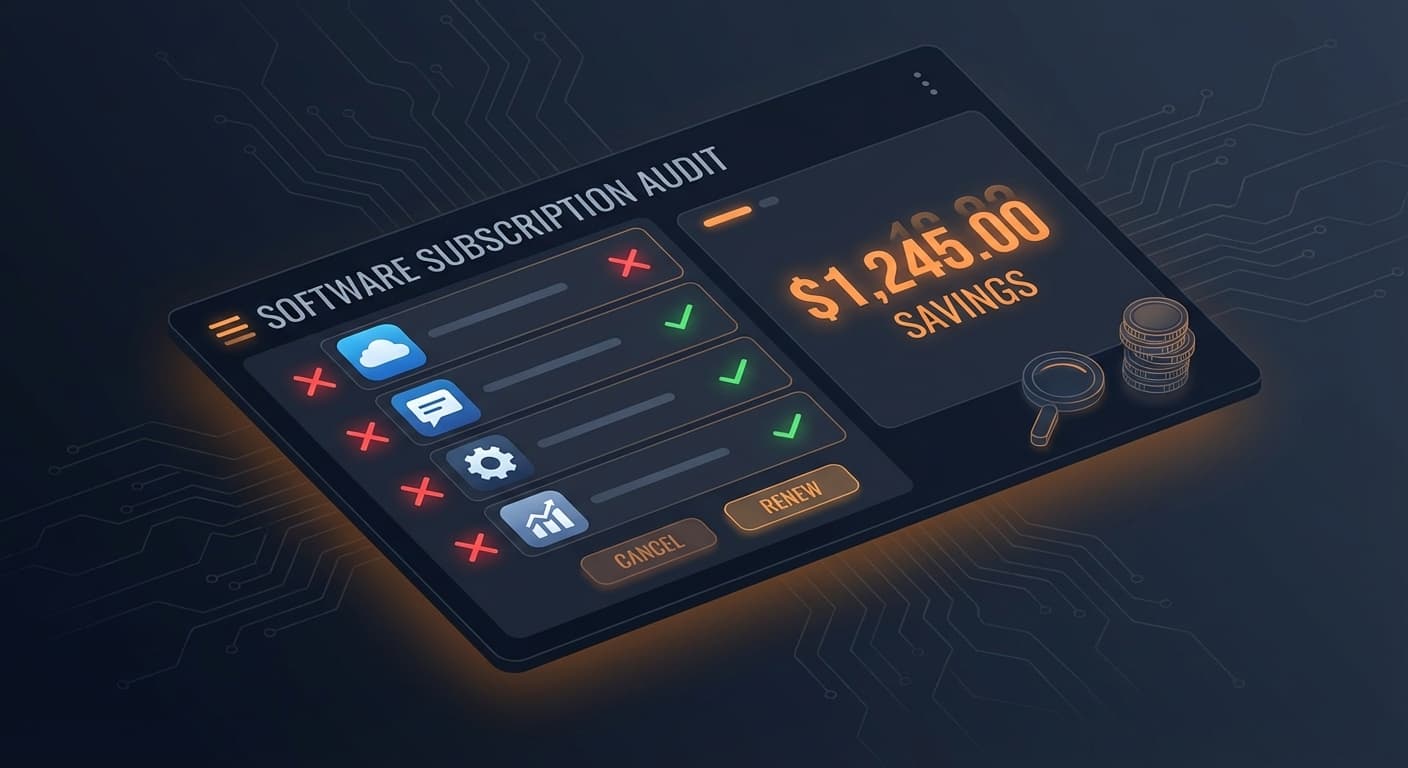
Here's exactly how to find out what's costing you money for nothing. Block 30 minutes. You'll need your bank statement and a simple spreadsheet or even a piece of paper. That's it.
Step 1: List every subscription (10 minutes)
Go through your last two months of bank and credit card statements. Write down every recurring software charge. Include the tool name, monthly cost, and what it's supposed to do in your business. Don't skip the small ones. That $12/month tool you forgot about is still $144/year, and you might have six of those.
Common places subscriptions hide: personal credit cards you also use for business, PayPal recurring payments, annual charges that hit once and disappear from your memory, and "lifetime" deals that actually had a recurring component you didn't notice.
Step 2: Rate each tool honestly (10 minutes)
Next to each subscription, write one of three ratings:
"Use Daily/Weekly" - You or your team actively use this tool multiple times per week. It's embedded in your workflow. If it disappeared tomorrow, you'd notice within hours.
"Use Sometimes" - You log in a few times a month. It does something useful occasionally, but it's not central to daily operations. If it disappeared, you'd notice within a couple of weeks.
"Forgot I Had This" - You can't remember the last time you logged in. You might not even remember your password. If it disappeared, you might not notice for months.
Be ruthless. If you're rating something "Use Sometimes" but you're being generous because you feel like you should be using it more, that's a "Forgot I Had This."
Step 3: Check for overlaps (5 minutes)
Look at your "Use Daily/Weekly" tools. Do any of them have features that overlap with other tools on your list? Common overlaps:
Your CRM probably has email marketing features you're paying a separate tool for.
Your project management tool probably has basic CRM or pipeline features.
Your email tool probably has landing page builders.
Your automation platform probably has features that duplicate what two other tools do natively.
Circle any tool where you're paying for a standalone solution to a problem that's already solvable inside a tool you're already paying for.
Step 4: Calculate the damage (5 minutes)
Add up the monthly cost of every tool rated "Forgot I Had This." Then add 50% of the cost of every tool rated "Use Sometimes" (because you're getting, at best, half the value). Then add the cost of any overlap tools you circled.
That total is what your tech stack bloat is costing you every month. For most entrepreneurs, it's $400 to $1,200 per month. That's $4,800 to $14,400 per year in software that's either unused, underused, or redundant.
What to Do With What You Find
Now that you can see the waste, here's how to start fixing it without breaking anything that's actually working.
1. Cancel the "Forgot I Had This" tools today.
Not tomorrow. Not "after I check if we need it." Today. If you haven't logged in for two months, you don't need it. If you cancel and discover in three weeks that you actually did need something it provided, you can resubscribe. Most SaaS tools will happily take your money again. But 90% of the time, you'll cancel and never think about it again.
This is the easiest money you'll ever save. It takes five minutes per tool and the savings start immediately.
2. Consolidate before you add.
Before you sign up for any new tool, ask: "Can something I'm already paying for do this?" The answer is yes more often than you'd think. Most modern SaaS platforms have expanded their feature sets significantly. The CRM you signed up for in 2023 probably has email marketing, landing pages, and basic automation now. The project management tool probably has time tracking and reporting. You might be paying for five tools when two would cover everything.
Spend an hour exploring the full feature set of your top two or three "Use Daily" tools. You'll likely find capabilities you didn't know existed that can replace a standalone subscription.
3. Build what you actually need instead of renting what you mostly don't.
This is the move that changes the equation entirely. For a lot of the tools on your list, you're paying monthly for a general-purpose platform and using one specific feature. That $299/month analytics dashboard? You're using one report. That $197/month automation platform? You're running two workflows.
What if instead of renting a tool that does 50 things and using three of them, you built exactly the three things you need? With modern no-code and AI-powered development tools, this is no longer a fantasy. Business owners are building custom dashboards, lead generators, and automation workflows that do precisely what they need, without the monthly subscription and without the 47 features they'll never touch. (I wrote a full guide on how to build custom business software without writing code - it's more accessible than you think.)
4. Set a quarterly "subscription review" calendar reminder.
Tech stack bloat is a recurring problem because subscriptions are designed to be forgotten. Set a reminder every 90 days to run through this audit again. It takes 15 minutes once you've done it the first time, and it catches the new tools that crept in before they become year-long commitments.
5. Track the savings and reinvest them intentionally.
When you cancel $600/month in unused software, don't just let that money disappear into general revenue. Track it. Know exactly how much you've saved. Then make a conscious decision about where that money goes - whether that's a tool you'll actually use, implementation support to get more from your existing stack, or straight to your bottom line.
The Bigger Picture
Here's what a clean tech stack actually does for your business beyond the obvious cost savings.
You make better decisions because your data lives in fewer places and actually connects. You move faster because you're not jumping between eight platforms to complete one task. You onboard team members easier because there are four tools to learn instead of fourteen. And you stop carrying the mental weight of knowing you're wasting money on things you don't use.
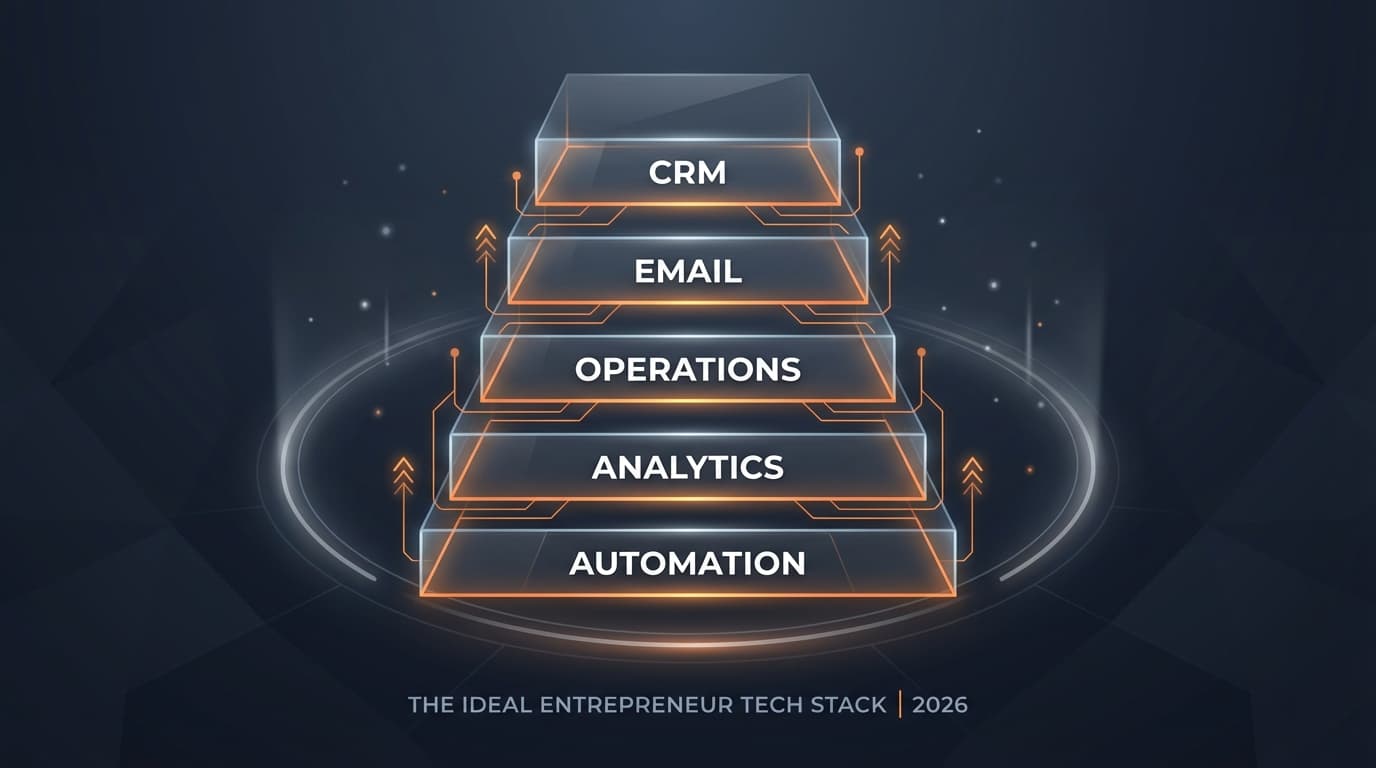
A lean tech stack isn't about having less. It's about having what works and nothing that doesn't. (If you want a complete framework for what that lean stack should look like in practice, I wrote The Entrepreneur's Tech Stack in 2026 - an opinionated guide to the five categories every business needs and nothing else.)
Every new Implementation Club member gets access to our Tech Stack Tracker in their first 48 hours. Instead of manually combing through bank statements and building a spreadsheet, you upload your statements and our tool does the analysis for you - identifying every subscription, flagging overlaps, calculating waste, and giving you a clear picture of where your money is actually going. At minimum, you'll have a better understanding of your real software costs. Most members find $400-800/month in immediate savings, which more than covers the cost of membership.
And it doesn't stop at the initial analysis. The tracker keeps running, so when a new subscription creeps in or an underused tool hits its renewal, you'll know about it before it becomes another forgotten line on your credit card. Inside the Slack community, members share what's working in their stacks, flag tools that aren't worth the money, and help each other consolidate. On Thursdays, we regularly help members migrate off expensive platforms and onto leaner setups that actually work together.
If you ran the audit above and didn't love what you found, this is the kind of thing we do every week in the Implementation Club.

Jon Barrett
Jon Barrett is the founder of Implementation Club — a community for entrepreneurs who are done planning and ready to build. He's spent 20+ years building operational systems for businesses of every size, and now helps owners implement faster, get unstuck in real-time, and finally build the business they've been describing to people for years.