systems
Stop Scaling a Broken Business: Why Your Next Dollar Should Go to Optimization, Not Marketing
Every business guru is telling you the same thing right now: run more ads. Build more funnels. Scale your content. Hire a media buyer. Get more traffic.
And it sounds right. More traffic means more leads. More leads means more revenue. More revenue means growth. Simple math.
Except the math only works if the rest of your business can handle what you're pouring in. And for most entrepreneurs doing $250K to $2M, it can't. Not even close.
You're scaling a leaky bucket. And the harder you pour, the faster you lose.
The Leaky Bucket Problem
Here's a scenario I see constantly.
An entrepreneur is doing $80K a month. They want to hit $120K. So they increase their ad spend from $5,000 to $10,000 per month. Traffic goes up. Leads go up. And revenue goes up - a little. Maybe they hit $90K. Maybe $95K on a good month.
But expenses went up by $5,000 plus the cost of fulfilling those extra leads. And the owner is now working an additional 10 hours a week handling the increased volume because there aren't systems in place to absorb it. Customer satisfaction dips because response times slow down. The team is stretched thin. Things start falling through the cracks.
They scaled the input without fixing the machine that processes it.
Meanwhile, another entrepreneur at $80K per month does something different. Instead of increasing ad spend, they spend a month looking at their existing numbers. They discover that their email follow-up sequence has a 0.3% conversion rate because it's two generic emails followed by nothing. They find out that 40% of their leads never get a response within the first 24 hours because nobody's assigned to handle them. They realize their pricing hasn't been reviewed in 18 months and they're undercharging relative to the value they deliver.
They fix the follow-up sequence. They assign and automate lead response. They adjust pricing by 15%.
Revenue goes from $80K to $110K. No additional ad spend. No additional hours. The machine got more efficient at converting what was already coming in.
That's the difference between scaling and optimizing. And almost everyone is doing the first when they should be doing the second.
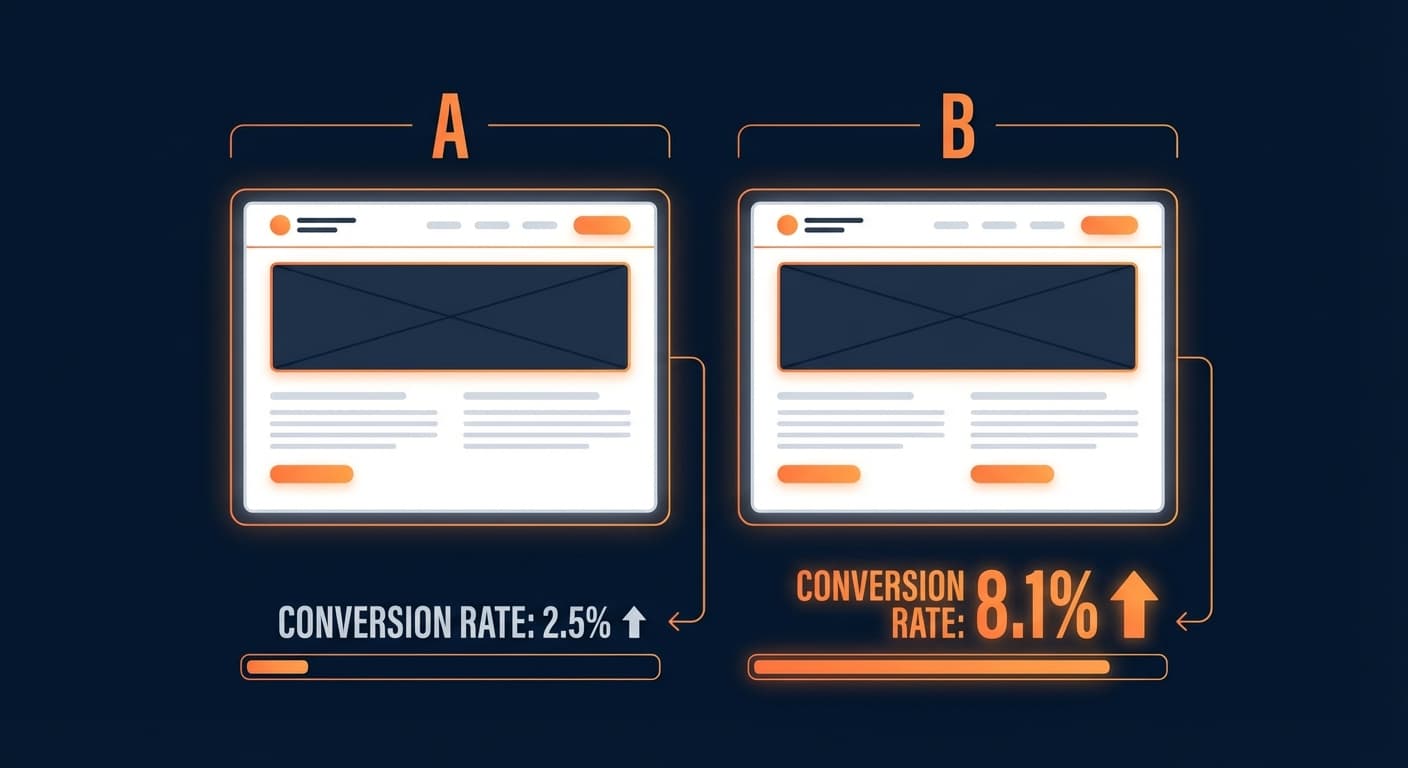
I saw this at a much larger scale with Derek Emery's company, which was doing about $40 million a year. The temptation at that level is the same - throw more money at marketing. Instead, we looked at the existing funnel. Their main landing page was converting at 18%. We tested and optimized it to 36%. Same traffic. Same ad spend. Same offer. Doubled the leads overnight. Derek's company grew to roughly $55 million over the following months - an extra $15 million in revenue without spending an additional dollar on advertising. They weren't under-marketed. They were under-optimized. And the optimization cost almost nothing compared to what scaling would have required.
Why Everyone Tells You to Scale (And Why They're Wrong)
The "scale first" advice isn't malicious. It comes from a real place: growth is exciting, and marketing is the most visible lever in a business. You can see the ads running. You can count the leads. You can measure the spend.
Optimization, on the other hand, is invisible. Nobody posts on LinkedIn about how they fixed their email sequence and made an extra $30K this year. Nobody runs a webinar about how they discovered 40% of their leads were falling through the cracks and plugged the hole. It's not glamorous work. But it's where the money actually is.
Here's the math most people don't run:
If you're converting 2% of your leads into customers, doubling your traffic doubles your customer count. That's a 2x return, minus whatever you paid for the traffic.
But if you're converting 2% and you optimize to 4%, you've doubled your customer count with zero additional traffic. That's not a 2x return. That's an infinite return on investment because the input cost was almost nothing.
The same principle applies to every stage of your business. Retention, upsells, pricing, fulfillment efficiency, lead response time, customer experience - each of these has an optimization opportunity that costs almost nothing to improve and produces disproportionate results.
You don't need more leads. You need to get more from the leads you already have.
The SOLID Framework: Fix the Foundation Before You Scale
After 24 years of working inside hundreds of businesses, I developed a framework for how to approach growth that's the opposite of what most people teach. I call it SOLID, and the core principle is simple: optimize what you've already got before adding anything new.
S - Stats and Analytics
You can't fix what you can't see. Step one is always knowing your numbers. Not the vanity metrics you glance at on Monday morning - the real numbers that tell the story of your business.
What's your actual conversion rate at each stage of your funnel? Not what you think it is. What the data says it is. What's your lead response time? What's your customer acquisition cost broken down by channel? What's your retention rate? What's your average revenue per customer? What are your real profit margins on each service?
Most entrepreneurs I work with can't answer more than two of these questions with confidence. They're making $500K to $2M in decisions based on gut feel and assumptions. That's not a strategy. That's gambling.
Setting up proper tracking is the least exciting work in business. It's also the most important. Because once you can see the numbers, the numbers tell you exactly where to focus. (A good place to start: audit your tech stack. Half the tools you're paying for might not even be connected to your analytics.)
O - Opportunities
Once you have real data, patterns emerge immediately. You'll see that one traffic source converts at 5x the rate of another - but you've been splitting your budget equally. You'll find that your repeat customers spend 3x what first-time customers spend - but you have no system for encouraging repeat business. You'll discover that 30% of your proposals don't convert because you're too slow to follow up, not because your pricing is wrong.
These are opportunities hiding in your existing business. They don't require more traffic, more tools, or more hours. They require attention and implementation.
The goal at this stage is to identify the three highest-leverage opportunities - the places where a small change would produce a disproportionate result. Not ten opportunities. Three. Because three implemented beats ten planned, every single time.
L - Leverage Systems and Automations
Now that you know where the opportunities are, you build the systems to capture them. This is where processes, automations, templates, and workflows come in.
That lead follow-up that's falling through the cracks? Build an automated sequence that responds within 5 minutes, follows up at 24 hours, and follows up again at 72 hours. That onboarding process that's different every time? Document it once, template it, and hand it to your team. That reporting you do manually every Monday? Automate it so the dashboard updates itself.
The goal isn't to automate everything. The goal is to automate the things that are currently leaking time or money so that your business runs more efficiently without requiring more of your hours.
I - Increase Conversion
With systems running and data flowing, you start optimizing for performance. This is where split-testing, copy improvements, offer refinements, and pricing adjustments come in.
Test your headline. Test your email subject lines. Test your call-to-action. Test your pricing page. (If you've never run a split-test before, this guide walks you through your first one - it's simpler than you think.) Small improvements at each stage of your funnel compound into massive results. A 10% improvement in conversion at three stages of your funnel doesn't give you 30% more revenue. It gives you compounded growth: 1.1 x 1.1 x 1.1 = 33% more revenue from the same traffic.
This is the optimization work that nobody talks about because it's not flashy. But it's where businesses quietly double their revenue without doubling their workload.
D - Deploy Marketing
Now - and only now - you scale.
When your tracking is solid, your opportunities are identified, your systems are running, and your conversion is optimized, THEN you pour fuel on the fire. Because now the machine works. Now more traffic actually translates to proportionally more revenue instead of proportionally more chaos.
This is when you increase ad spend. This is when you launch the new funnel. This is when you hire the content team. Not before the foundation is set, but after.
The difference is night and day. Scaling a broken business feels like running faster on a treadmill. Scaling an optimized business feels like the wind is at your back.
How to Start Optimizing This Week
You don't need to implement the entire SOLID framework tomorrow. But you can start seeing results this week with a few focused moves.
1. Pick one number you should know but don't.
Not all your numbers. One. Maybe it's your email open rate. Maybe it's your lead-to-customer conversion rate. Maybe it's how long it takes your team to respond to a new lead. Pick the one that feels most directly connected to revenue, and go find the actual answer. Not your assumption. The real data.
That single number will likely tell you something you didn't expect, and it will point you toward an optimization opportunity you didn't know existed.
2. Find your biggest leak.
Ask yourself: "Where am I losing the most potential revenue with the least effort to fix it?" Common leaks: leads that come in but never get followed up with. Customers who buy once but never hear from you again. A pricing model that hasn't changed in two years despite the value you deliver going up significantly. Proposals that sit in someone's inbox for a week because your follow-up is manual and inconsistent.
You probably already know what your biggest leak is. You've been meaning to fix it for months. The knowing isn't the problem.
3. Fix one leak before you spend another dollar on marketing.
Take that leak you identified and spend this week's marketing energy on fixing it instead of generating more traffic. If your email follow-up is broken, fix the sequence. If your lead response time is too slow, set up a basic automation or assign someone to own it. If your pricing is outdated, do the analysis and adjust it.
One fixed leak will likely produce more revenue this quarter than any ad campaign you'd run in the same timeframe. Because you're not adding more water to the bucket - you're plugging the hole that's been draining it.
4. Run the "foundation check" before any new initiative.
Before you launch the next funnel, run the next campaign, or sign up for the next platform, ask: "Is my current system optimized to handle what I already have?" If the answer is no, optimization comes first. Always. Scaling an unoptimized business just creates more expensive chaos.
5. Calculate the cost of one unoptimized stage.
Pick one stage of your customer journey and calculate what a 20% improvement would be worth annually. For example, if you get 100 leads a month and convert 3%, that's 3 customers. If you optimized to 3.6% (a 20% improvement), that's 3.6 customers per month - an extra 7 customers per year. Multiply by your average customer value. For most service businesses, that one optimization at one stage is worth $10K to $50K annually. And it costs almost nothing to implement.
When you see that number, "should I optimize or should I scale?" stops being a philosophical question and becomes obvious math.
The Uncomfortable Truth About Growth
Most entrepreneurs are addicted to the idea of growth through addition. More traffic. More tools. More team members. More offers. It feels like progress because it's visible and active.
But the businesses that grow the fastest and most sustainably are the ones that master subtraction first. Remove the waste. Fix the leaks. Optimize what's already there. Build on a solid foundation instead of pouring more into a shaky one.
It's less exciting. It's less shareable on social media. And it works dramatically better.
This is exactly the approach we take in the Implementation Club. We don't start with your marketing budget. We start with your numbers - what's actually happening in your business right now. We find the leaks, the opportunities, and the optimizations that are hiding in your existing operations. Then we help you implement them, one at a time, every Thursday.
Members regularly find $5K to $20K in annual revenue hiding in their current business before we touch anything new. Not because the money wasn't there - because nobody had helped them look for it with the right framework and the support to actually fix what they found.
In Slack, members share their wins from optimization work all the time. "Fixed my follow-up sequence, closed three deals that would have gone cold." "Raised my prices 12%, no pushback from clients." "Automated my onboarding - saved 6 hours a week." These aren't marketing wins. They're optimization wins. And they compound.
The next dollar you spend on your business probably shouldn't go to marketing. It should go to making sure the machine works before you turn up the volume.

Jon Barrett
Jon Barrett is the founder of Implementation Club — a community for entrepreneurs who are done planning and ready to build. He's spent 20+ years building operational systems for businesses of every size, and now helps owners implement faster, get unstuck in real-time, and finally build the business they've been describing to people for years.