systems
The DOOR System: How to Document Any Process So Anyone Can Follow It
Quick test. Pick the most important repeatable task in your business. The thing you do every week - or every time a new client signs up, or every time a project kicks off. The thing that has to happen right or something breaks downstream.
Now answer this: if you got hit by a bus tomorrow, could someone on your team do that task by Friday?
Not "figure it out eventually." Not "muddle through a version of it." Could they execute it at your standard, hitting every step, in the right order, without calling you from the hospital bed to ask what happens after step three?
If you hesitated, that process lives in your head. And as long as it lives in your head, you are the bottleneck. You are the single point of failure. You are the reason you can't take a vacation, can't step back from operations, and can't grow past the ceiling of your own available hours.
This isn't a delegation problem. It's an extraction problem. The knowledge exists - it's just trapped inside you. And nobody's given you a method for getting it out.
Until now.
Why Most "Just Document It" Advice Fails
You've heard the advice. "Write SOPs." "Document your processes." "Create systems."
And you've probably tried. You opened a Google Doc, wrote down five or six high-level steps, got interrupted by a client call, and never came back to it. Or you wrote out the full process, handed it to a team member, and they did it wrong because your documentation skipped the 14 micro-steps your brain fills in automatically without you even noticing.
The problem isn't willpower. It's method. "Just document it" is like telling someone "just write a book." Technically accurate, completely unhelpful. Without a structured approach to process creation, you'll either never start, never finish, or produce something that doesn't actually work when someone else tries to follow it.
What you need isn't motivation to document. You need a system for building systems. (If you haven't already, read Everything Is a Systems Issue first - it covers the mindset shift that makes everything in this article land harder.)
The DOOR System: Four Phases of Process Creation
After 24 years of building processes for businesses - and watching hundreds of entrepreneurs try and fail to extract what's in their heads - I developed a framework called the DOOR System. It's how we create proven, repeatable processes that produce the same result every time, regardless of who implements them.
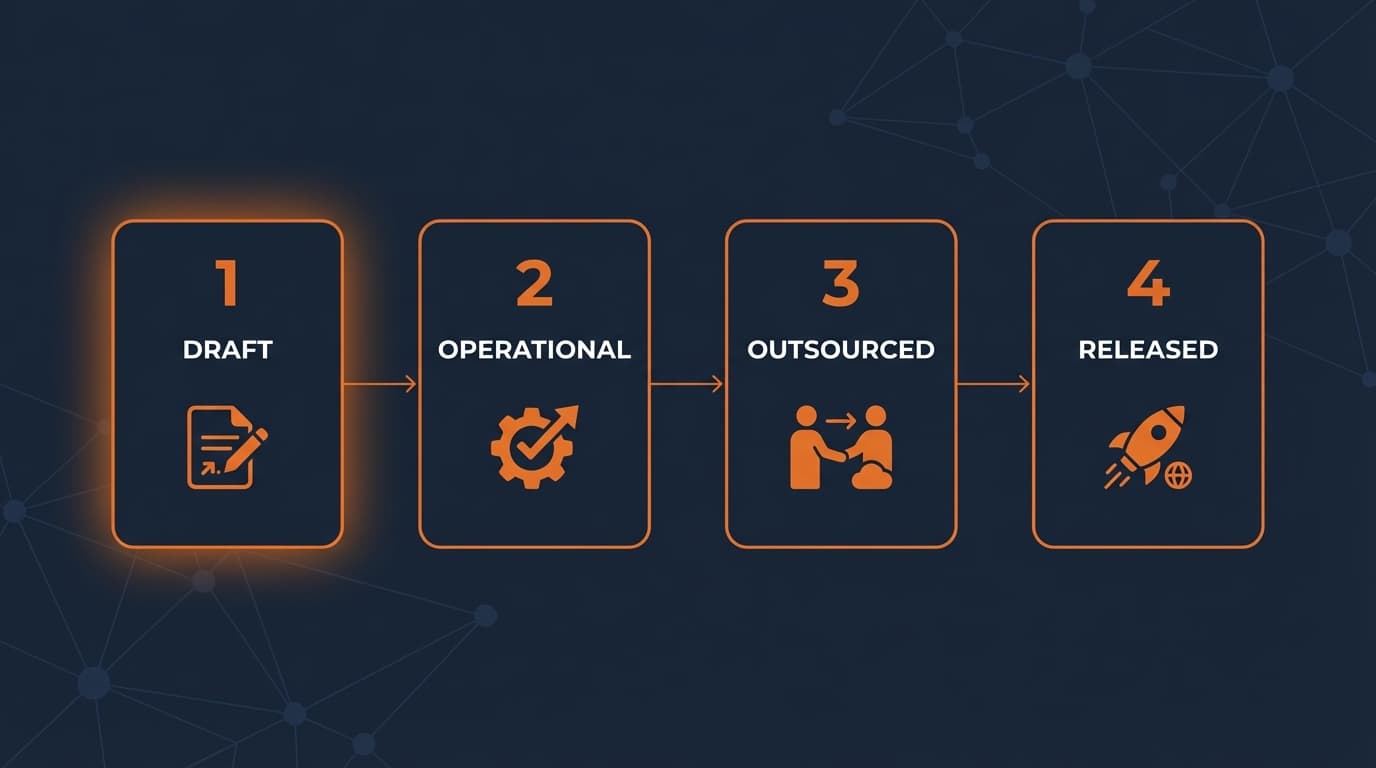
DOOR stands for four phases:

Draft - Get it out of your head, messy and imperfect. Operational - Refine it by running it yourself, exactly as written. Outsourced - Prove it works by having someone else execute it. Released - Lock it in as a proven system that runs without you.
Each phase has specific steps. The whole process is designed so that by the time you reach "Released," you have something you'd stake your reputation on - because it's been tested, refined, and validated by real execution, not just theory.
Let's walk through it.
Phase 1: Draft (Get It Out of Your Head)
The goal of this phase is speed, not perfection. You're doing a brain dump - getting the process out of your head and onto paper before your inner perfectionist can stop you.
Write out every step you can think of, start to finish. Don't stop to edit. Don't worry about order. Don't agonize over whether you're being specific enough. Just get it all down as separate items - one action per line. If you think of something out of order, write it anyway. You'll reorganize later.
Most people stall here because they try to write a perfect SOP on the first pass. That's Phase 2 work. (If perfectionism is your pattern, this is where it'll try to hijack you. Resist it.) In Phase 1, your only job is extraction. Treat it like you're dictating to someone while walking them through the task. Stream of consciousness is fine. "Then I check the thing - oh wait, before that I log in - and then I look at the numbers" is a perfectly valid Draft output.
Then go back through slowly and get specific. This is where the real work happens. Take each step and ask: "Could someone who's never done this follow this instruction without asking me a question?"
Here's the difference that matters. A vague step looks like:
"Post article on the blog."
A specific step looks like:
Log into WordPress at www.domain.com/wp-admin using the username and password stored in the shared password manager under "Company Blog." Click on "Posts," then "Add New." Enter the title of the post into the Title field. Paste the article content into the Content section. Select the category that matches the topic. Click the blue "Publish" button in the top-right corner. After the page refreshes, click "View page" and review the post for formatting errors, broken images, and typos.
See the difference? The first version requires the person to already know how your blog works. The second version could be followed by anyone who can read. That's the standard you're aiming for.
Finally, add what should be happening - not just what is happening. This is where your Draft becomes aspirational. Look at the process you've documented and ask: "If this process were ideal, what else would be included?"
Maybe your webinar process has 40 steps but you know it would be stronger with a retargeting ad sequence afterward. Maybe your client onboarding works fine but would be better with a personalized welcome video. Add those aspirational steps now. Mark them as additions so you know they're new, but include them. You're building the best version of this process, not just documenting the current one.
By the end of Phase 1, you have a messy, detailed, comprehensive draft. It won't be pretty. It doesn't need to be. It just needs to be complete.
Phase 2: Operational (Prove It Works By Doing It)
This is the phase most people skip - and it's the phase that makes everything else work.
Execute the entire process yourself, following only what's written. Not what you know. Not what you remember. Only what's on the document. Turn off your brain and pretend you're a robot that can only do exactly what the instructions say.
This is harder than it sounds. Your instincts will try to fill in gaps automatically. You'll catch yourself doing something that isn't written down and thinking "well, obviously you'd do that." Stop. If it's not in the document, add it. If a step is unclear, rewrite it until it's unmistakable. If you find yourself making a judgment call, that judgment call needs to become an explicit instruction.
Every time you deviate from the written process - every time you add a step, skip a step, or interpret a step differently than what's written - you've found a gap. Fix it before moving forward.
Check the end result against your standard. When you've completed the full process following only the documentation, evaluate the output. Does it match what you'd consider acceptable? If not, figure out where the process produced the wrong result and adjust.
This step is where your process goes from "I think this covers everything" to "I've verified this covers everything." The difference is the difference between a guess and proof.
Phase 3: Outsourced (Prove Someone Else Can Do It)
A process that only works when you do it isn't a system. It's a dependency. Phase 3 breaks that dependency.
Hand the process to someone else and have them execute it, start to finish. Depending on the complexity, you can watch them do it, let them ask questions when stuck, or just review the finished output. Any approach works - the point is to find every place where someone who isn't you gets confused, stuck, or produces the wrong result.
When they hit a snag - and they will - resist the urge to explain verbally. Instead, note what confused them and go back to the document to fix it. Verbal explanations are duct tape. Written clarification is a permanent fix.
Refine based on what you learned, then have someone do it again. The second time through should be dramatically smoother. At this point you've drafted it, refined it yourself, had someone else test it, and refined it again. The process is now battle-tested.
You'll always find small improvements over time - better tools, clearer phrasing, steps that can be combined. But after Phase 3, you have a process that provably works in someone else's hands. That's the milestone. That's when it stops being knowledge trapped in your head and starts being a business asset. (For a detailed framework on how to hand processes off effectively - including the "Watch me, do it with me, do it alone" sequence - see the delegation system.)
Phase 4: Released (Lock It In and Optimize)
A Released process is one you'd stake your reputation on. It produces consistent results regardless of who runs it. This is where the process becomes a true system - and where the real leverage begins.
Automate every step you can. Look at your refined process and ask: which of these steps can be handled by technology instead of a person? Email sequences that trigger automatically. Data that populates without manual entry. Notifications that fire when a step is completed. Reports that generate themselves.
Every step you automate is a step that never gets forgotten, never gets done late, and never gets done wrong because someone had a bad day. Automation doesn't replace the process - it executes parts of it with perfect consistency.
In 2026, the automation possibilities are dramatically broader than even two years ago. AI can handle steps that previously required human judgment - drafting communications, analyzing data, routing decisions based on criteria you define. Steps that used to require a person can now run in the background while your team focuses on the parts that genuinely need human involvement.
Test the automated version end to end. Automation that mostly works is worse than no automation - it creates false confidence. Run the full process with automation active and verify that every automated step produces the correct output. If something breaks, either fix the automation or revert that step to manual until you can make it reliable.
When steps get automated, simplify the documentation. If 8 manual steps become one automation trigger, the checklist should show one step: "Trigger the automation sequence in [platform]." The person running the process shouldn't need to understand the 8 automated steps - they just need to know how to start it and how to verify the output.
Monitor, get feedback, and refine continuously. A Released process isn't finished - it's maintained. Review the results regularly. Talk to the person implementing it: Are there steps that could be eliminated? Tools that would speed things up? Gaps that cause problems? And watch for patterns in customer or team feedback - recurring complaints often point to a process step that needs adjustment.
The beauty of having a documented, tested process is that when something goes wrong, you don't blame people. You fix the system. The result wasn't right? Adjust the step. The team member missed something? Clarify the instruction. The automation broke? Debug the workflow. The system is always the variable, not the person. That mindset shift - from managing people to managing processes - is what lets you scale without burning out.
What This Looks Like in Practice
Let's say you want to systematize your new client onboarding. Here's how DOOR plays out:
Draft: You brain-dump everything that happens when a new client signs up. Send welcome email. Set up their folder. Schedule kickoff call. Create project timeline. Add to CRM. Send contract. Collect payment info. Assign team members. It's messy - some steps are out of order, some are vague. That's fine.
Operational: You go back through and get specific. "Send welcome email" becomes "Open the welcome email template in [platform], customize the subject line with the client's first name, update the kickoff call link with their specific scheduling URL, and send within 2 hours of contract signature." You follow the whole process yourself for your next new client, documenting every micro-step your brain was silently filling in.
Outsourced: You hand the refined process to a team member for your next new client. They follow it step by step. They get stuck on step 7 because you forgot to specify which project template to use. You fix it. They run it again for the next client. Clean execution.
Released: You identify 6 steps that can be automated. The welcome email triggers automatically when the contract is signed. The folder structure creates itself. The CRM updates without manual entry. The project timeline populates from a template. Your team member now handles 4 manual steps instead of 10, and the automated steps happen instantly with zero errors. You review the process quarterly and refine based on client feedback.
What started as "I handle onboarding myself because nobody else knows how" became a system that runs whether you're in the office, on vacation, or asleep. The result is the same every time. That's what Released looks like.
The Process That Builds Every Other Process
Here's what makes DOOR compound: once you've used it to build one process, building the next one takes half the time. Not because the steps change - because your skill at extraction improves. You get faster at identifying the micro-steps your brain skips. You get better at writing instructions that don't require clarification. You develop an instinct for which steps are automatable before you even finish the Draft phase.
Your first DOOR process might take a full week across all four phases. Your fifth takes two days. Your tenth takes an afternoon. And each one removes another task from your plate permanently while maintaining or improving the quality of the output.
Within 90 days of building one process per week, you have 12 documented, tested, partially automated systems. That's 12 tasks that no longer require your involvement. 12 fewer reasons you can't take a Thursday off. 12 fewer things that break when you're not watching.
That's how you stop being the bottleneck in your own business. Not by working harder or delegating blindly. By methodically extracting what's in your head, proving it works in someone else's hands, and automating everything that doesn't need a human touch.
Building Systems Together
If you've read this and you're ready to build your first DOOR process, start today. Pick the task that annoys you most - the one you keep doing yourself because "it's faster" - and write the Draft. Brain dump. Don't edit. Just get it out of your head.
And if you want to build them faster, with less friction, and with automation that actually works - that's what we do every Thursday in the Implementation Club. You bring the process stuck in your head. We help you extract it, refine it, test it, and identify which steps can be automated using AI, integrations, and the tools you already have. By the end of the session, you walk out with a documented, testable system - not a plan to build one next week.
Between sessions, the Slack community is where members share their DOOR processes, troubleshoot the Outsourced phase when team members hit snags, and push each other to keep building their process library. When a result isn't perfect, we don't blame the person - we adjust the system, test it again, and make it better.
The goal isn't just documentation. It's building a business that produces consistent results through systems and automation - so you can focus on the work that actually requires you, and everything else runs without your constant involvement.
Your processes are your most valuable business asset. They're just trapped in your head. Let's get them out.

Jon Barrett
Jon Barrett is the founder of Implementation Club — a community for entrepreneurs who are done planning and ready to build. He's spent 20+ years building operational systems for businesses of every size, and now helps owners implement faster, get unstuck in real-time, and finally build the business they've been describing to people for years.